Current Research Project
The Remediation
of Nation
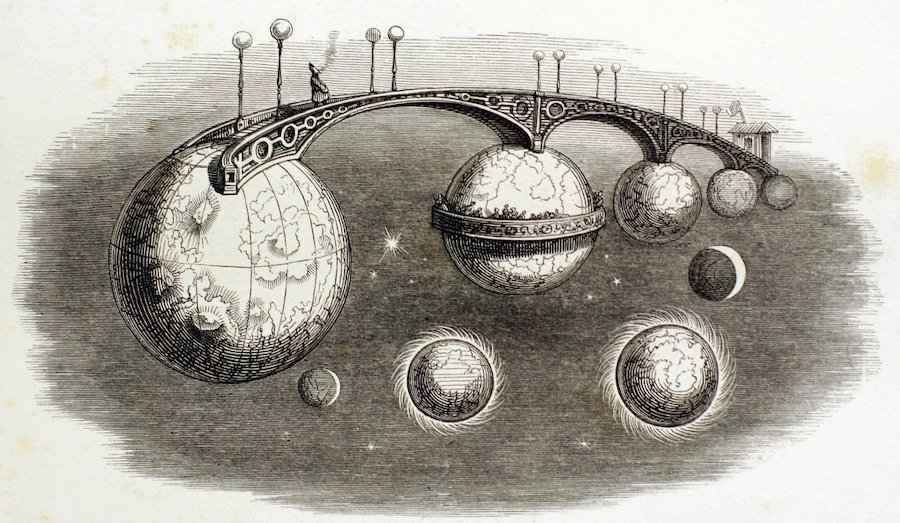
A study of how media — from 19th panoramas, to postwar radio and contemporary screen cultures — rehearse, repair, reform, and re-stage the idea of the nation.
A project by Birgit Haberpeuntner · Universität für Angewandte Kunst Wien, Abteilung Medientheorie · funded by the ÖAW APART-GSK Fellowship Programme
The Project
The Remediation of Nation
- Funding
- ÖAW · APART-GSK Fellowship
- Duration
- 2024 — 2030
- Host
- Angewandte · Medientheorie
The nation has, in a sense, always been a media phenomenon. As Benedict Anderson showed, it was media that first made the nation imaginable as a form of collective belonging. Media and nation have been intrinsically bound ever since.
For decades now, a crisis of the nation-state has been declared, not least by M. McLuhan, who considers print as "the architect of nationalism," and nationhood as intrinsic to the 'Gutenberg Galaxy' — inevitably to be replaced by the age of electronic media, and thus the 'Global Village.' Yet here we are, embedded in globalized media environments, and nationhood remains an efficacious principle of social organization.
Interrogating this stubborn persistence from a perspective of Medienkulturwissenschaft, the project explores the discipline's border zones with Nationalism Studies to advance our understanding of the relation between media and nation. Drawing on historical comparative research, it approaches nationhood as a dispositif: an arrangement of practices, institutions, and media that is continuously reshaped as its mediality shifts.
The guiding concept is remediation: media refashion not only other media, but also the social forms they help constitute — nationhood among them. The nation, on this view, is not what media represent but what media keep remaking. By tracing this dynamic across different media-historical moments, the project asks what the relation between media and nation must be like for the nation to remain so resilient, even under media conditions that were once expected to end it.
Updates
Upcoming
- 2026 Workshop Forthcoming · University of Applied Arts Vienna · CfP closed
A running record of talks, publications, and events tied to The Remediation of Nation.
Researcher
Birgit Haberpeuntner
Birgit Haberpeuntner is the principal investigator of The Remediation of Nation. She is a researcher at the Department of Media Theory at the University of Applied Arts Vienna (Angewandte) and works at the intersection of media studies and cultural history.
She studied English and American Studies and Theater, Film and Media Studies in Vienna, with research stays at Concordia University Montreal, Columbia University New York, and the Université de Montréal. She holds a PhD from the University of Vienna and has been a Junior Fellow at the International Research Center for Cultural Studies (IFK) and an APART-GSK Fellow of the Austrian Academy of Sciences. Her first monograph, Walter Benjamin and Cultural Translation, was published by Bloomsbury in 2024.
Selected Writing
- 2025 Österreichische Zeitschrift für Geschichtswissenschaften 36/2
- 2024 Bloomsbury
- 2023 Vorwerk 8 (co-edited)
Gesten des Ephemeren: Anschlüsse an Walter Benjamin
- 2022 Translation Studies 15
- 2021 V&R unipress (co-edited)
Plurale Autorschaft
- 2018 Böhlau (co-edited)
Walter Benjamin und das Kino
Previous Projects
Austrian Postwar Radio (1945–55)
- Role
- Project Leadership
- Duration
- 2022 — 2024
- Host
- University of Vienna · TFM
The Affective Construction of National Temporalities in Austrian Postwar Radio (1945–55) – ACONTRA for short – is a collaborative project between the University of Music and Performing Arts Vienna, the University of Vienna, and the House of Austrian History. It examines the role of radio as a mass medium in the process of constructing national consciousness during the early years of the Second Republic.
The starting point for this research is auditory source material from Austrian broadcasting institutions: drawing on existing programme recordings, the project analyses how imaginings and projections of the country's past and future are conveyed affectively through the sonic dimension, and how the medium thereby contributes to structuring national temporality and belonging.
Through close attention to programming, voice, scheduling, and sonic atmosphere, the project asked how broadcasting helped to organise affect, memory, and belonging in a country negotiating both rupture and continuity after 1945. Rather than treating radio as a neutral channel, the study read it as a medium in which "the nation" was rehearsed daily — through rhythms of address, modes of listening, and the temporal architectures of the programme schedule.
Focal Points
- The affective texture of postwar broadcasting: sound, voice, and atmosphere as historical evidence
- Radio scheduling as a technology of collective time
- Continuities and ruptures between wartime and postwar media practice
- Nationhood as a media-cultural form rather than a given category
Outputs & Events
- 2024 Conference hdgö & ORF Radiokulturhaus, Vienna
- 2025 Exhibition Haus der Geschichte Österreich, Vienna
Impressions
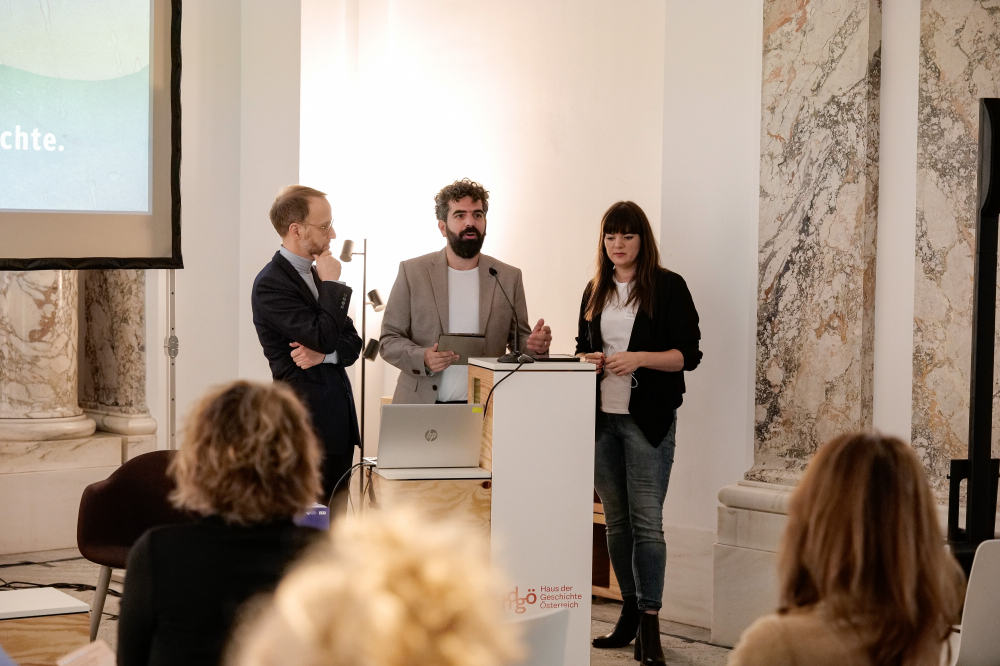
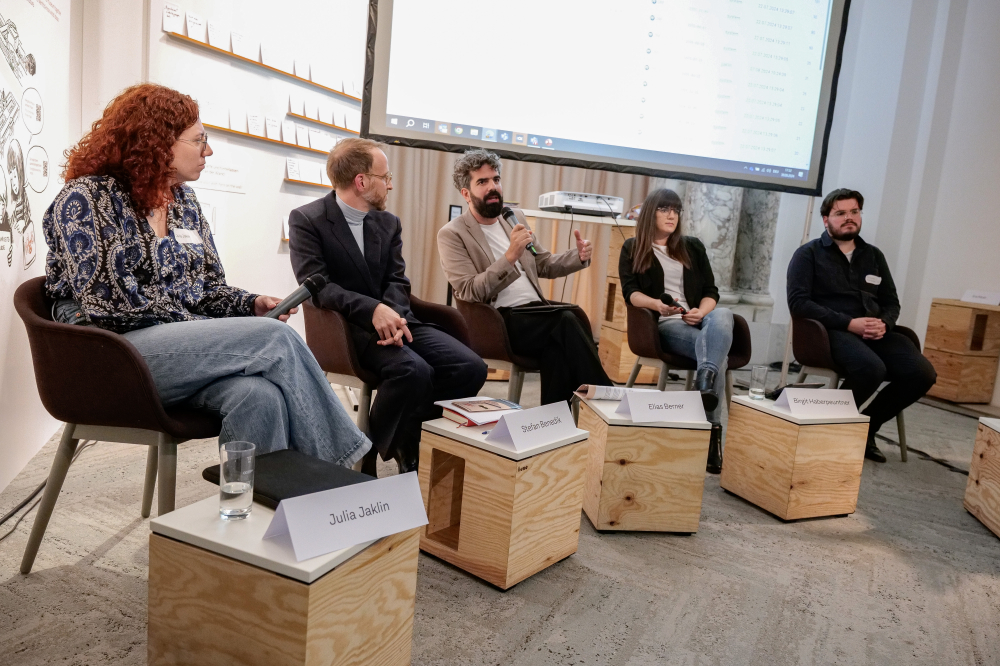
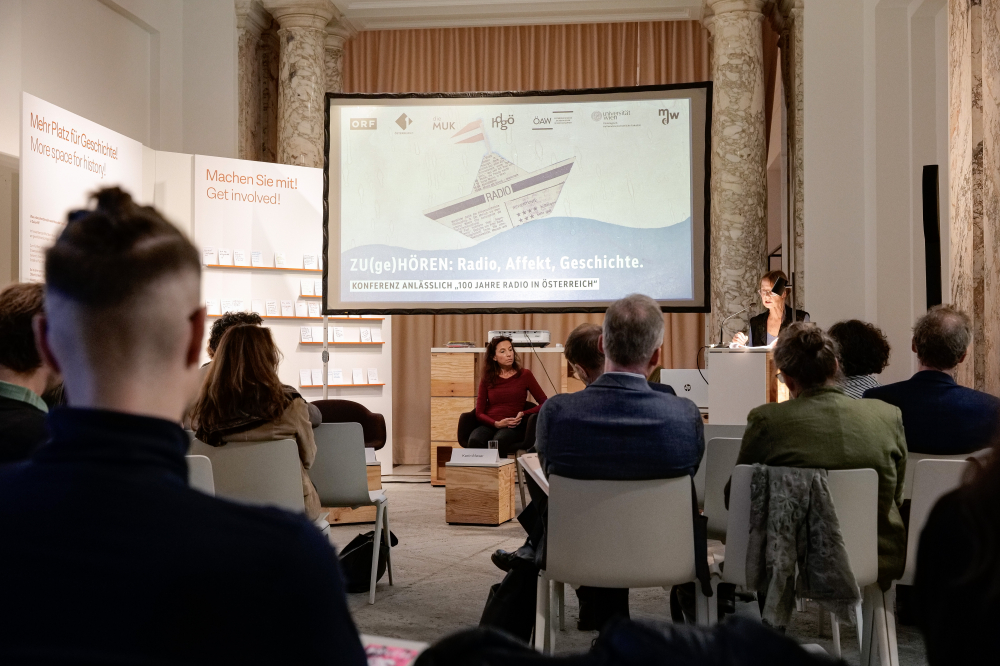
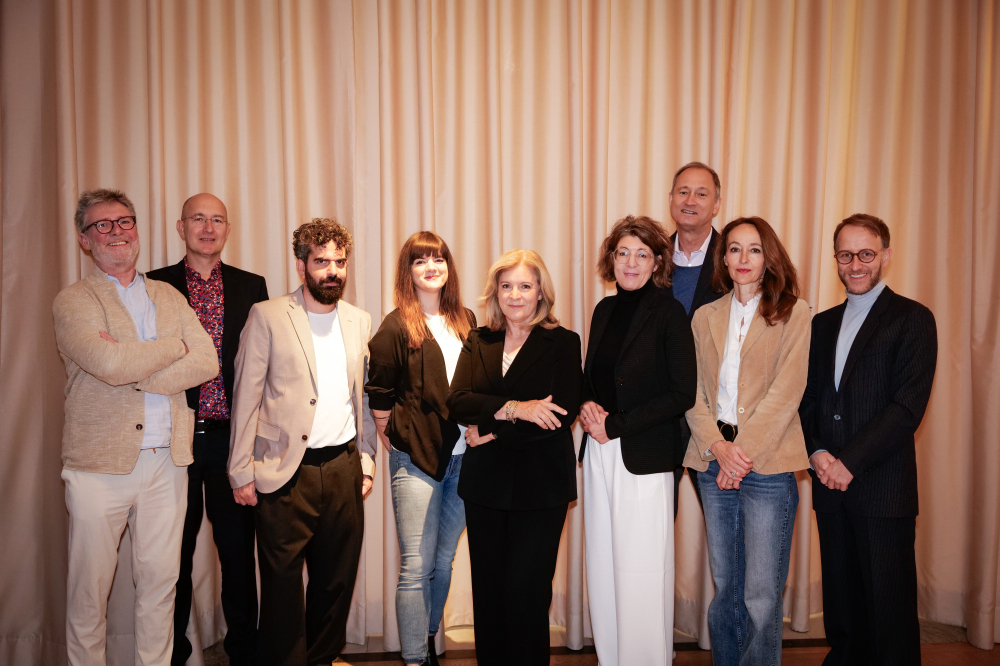
ZU(ge)HÖREN: Radio, Affekt, Geschichte — hdgö & ORF Radiokulturhaus, 2024 · Photos: David Tiefenthaler / hdgö, CC-BY-NC 4.0
Contact
Get in Touch
Affiliation
University of Applied Arts Vienna
Department of Media Theory
Vordere Zollamtsstraße 7, A-1030 Wien